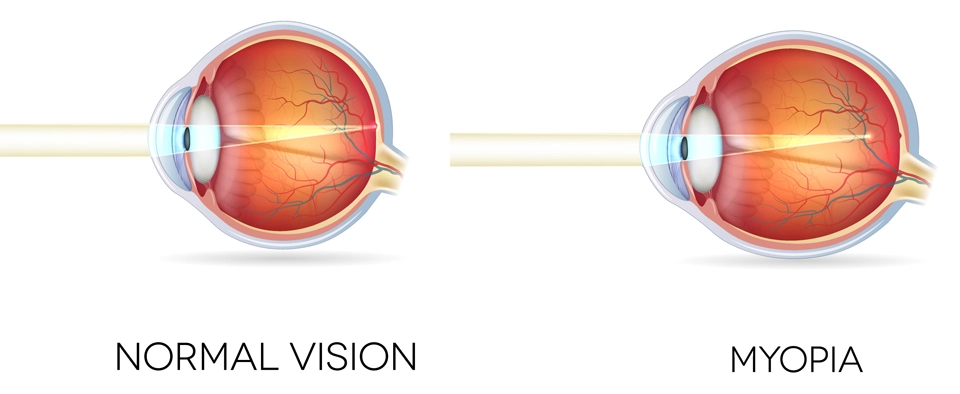
Myopia is a condition in which one can see nearby objects clearly but objects that are far away appear blurry. It occurs when the light is refracted incorrectly within the eye due to the eyeball being longer than normal. As a result, the image is focused in front of the retina instead of on the retina.
What Causes Myopia?
Excessive near work (screen time, television, digital devices)
Age (can start from pre-school to primary levels)
Less time spent outdoors
Family history of high myopia
What Are Some Symptoms of Myopia?
Parents should be alert for these symptoms of myopia in their children as the child would often not communicate directly the difficulties faced:
Persistent squinting
Frequent rubbing of eyes
Excessive blinking
Constantly needing to sit closer to the television or the front of the classroom to see clearly
Being unaware of distant objects
Needing to hold objects close to their face to see them
Risk Factors of Myopia in Children
Genetics: Near-sightedness tends to run in families. If one of your parents is nearsighted, your risk of developing the condition is increased. The risk is higher if both parents are nearsighted.
Prolonged close-up activities: Reading or doing other close-up activities for a long time is associated with an increased risk of near-sightedness.
Screen time: Studies have shown that children who use computers or smart devices for long periods have a greater risk of developing near sightedness.
Environmental conditions: Some studies support the idea that not spending enough time outdoors may increase the risk of near-sightedness.
What Are the Later Complications in Adulthood Associated With Myopia Progression in Childhood?
Retinal tear and detachment: The eye with high myopia is excessively elongated resulting in thinner retina. This puts the eye at greater risk of developing a retinal tear, hole or detachment. Retinal detachment requires urgent treatment as unless the detached retina is promptly reattached, there can be permanent loss of vision in the affected eye.
Macular degeneration: Severe myopia of more than 10 dioptres (1,000 degrees) may be associated with macular degeneration. The macula is the central part of the retina that gives the clearest vision. Macular degeneration causes difficulties in reading, watching TV and recognising people’s faces.
Cataract: High myopia is associated with earlier onset of cataract, which is clouding of the eye’s natural lens which causes blurring of vision.
Glaucoma: The optic nerve in highly-myopic individuals is intrinsically weaker and susceptible to damage even at normal levels of eye pressure. Also, glaucoma is associated with increased fluid pressure within the eyeball. Severe myopia increases the risk of developing glaucoma, which if left untreated over time can cause blindness.
How is Myopia in Children Diagnosed and Assessed?
Manifest refraction: The refractive power of the eye (degree is first determined without dilating eye drops to understand the usual visual status of the child.
Cyclorefraction: Eye drops will be administered to dilate the pupils and to accurately measure the refractive power of the eye, which is important in evaluating your child’s visual function.
3D vision and strabismus/squint: The eye doctor makes sure that, up close and at a distance, the eyes are aligned and there is no eye turn or strabismus/squint. 3D vision will also be tested in older children.
When Should You Bring Your Child to See an Eye Doctor?
When you look at your child, you notice that one eye is not aligned.
Your child has trouble focusing or squints a lot.
Your child holds books too close when reading.
Your child turns or tilts their head when they want to look at something.
Your child covers an eye when stepping into sunlight.
One of your child’s eyes is whiter and brighter than the other eye in a picture.
Your child moves closer to the blackboard or TV to see better.
Your child may not complain about not being able to see clearly because they are unaware that they might have myopia or astigmatism. Only you, as a parent, can make sure that any visual problem your child may have is caught early on.
How is Myopia in Children Treated?
Each child is different and has different rates of myopia progression. Treatment should be individualised based on each child’s lifestyle. Most cases of myopia are mild and easily managed with eyeglasses, contact lenses or refractive surgery.
Lifestyle modifications: Spending more time outdoors and reducing unnecessary near work (i.e. use of handheld devices) are important. Remember the 20/20/2 rule: after every 20 mins of near work, take a 20 second break and spend 2 hours of time outdoors per day.
Myopia control spectacle lenses: For children who are not comfortable with eye drops or contact lenses, myopia control spectacle lenses can help to control myopia progression.
Atropine eye drops: An ophthalmologist prescribe these eye drops to prevent the eyes from growing longer and the myopia increasing further. A range of different atropine concentrations are available which can be individualised to the myopia severity and activities of each child.
Ortho-keratology lens: These lenses are worn overnight, and reshape the cornea during the time that the child is asleep. During waking hours, the cornea retains its new shape and so the myopia is corrected for. Additionally, these lenses also reshape the peripheral cornea, and thus have a role in controlling myopia progression.
Daily disposable myopia control contact lenses: The central part of these contact lenses corrects refractive error, much like a traditional corrective lens. However, the peripheral part of the lens has specially-designed concentric rings that prevent further worsening of myopia by reducing the stimulus causing eyeball elongation.
Contact us
Request a Consultation
Wish to book a consultation or have a question? WhatsApp Us!