
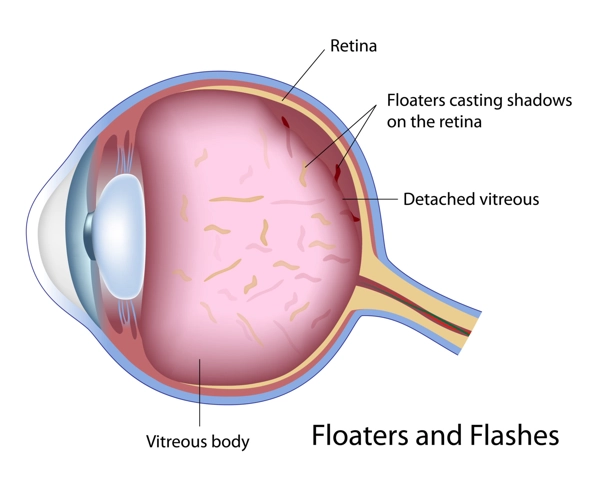
Floaters are small spots in the vision due to cells or opacities in the vitreous gel that cast a shadow on the retina. Floaters often move and come in all different sizes and shapes, including dots, blobs, squiggly lines, circles, or cobwebs. They may also give a “filter” effect where vision appears more blurry.
Floaters can be caused by several eye conditions, but the most common cause for floaters is a vitreous degeneration. When you are born, the vitreous gel in your eyes is firm, but as you get older, the gel softens and begins to liquify, forming ‘clumps’. As you move your eyes, these clumps move around and catch the light, much like how snowflakes in an ornamental snow globe behave when the globe is shaken. The movement of these ‘clumps’ casts shadows on the retina, giving rise to what we perceive as “floaters”.
The most common cause of flashes is tugging of the vitreous gel on the retina. The vitreous gel is normally attached to the retina. The retina contains many light-sensitive cells. As the vitreous gel softens with age, it pulls onto the retina and stimulates it, giving rise to what we perceive as flashes of light.
When flashes occur in conjunction with floaters, it means that there is sufficient tugging on the retina. Thus, flashes more strongly indicate the possibility of retinal tears and retinal detachments, than floaters.

Our clinic staff will call you within 48 hours to confirm your appointment. For urgent appointments, please call us at 8818 3788.
Wish to book a consultation or have a question? WhatsApp Us!