
Cataracts occur when the normal clear lens of the eye becomes cloudy, preventing light from passing through. This clouding is most commonly due to natural aging, as proteins within the lens gradually break down and clump together over time.

While aging is the primary cause, several other factors may contribute or accelerate cataract formation. These include prolonged exposure to ultraviolet (UV) light, smoking, excessive alcohol intake, and long-term use of certain medications, such as corticosteroids.
Medical conditions like diabetes, previous eye injuries or inflammation, and a family history of cataracts may also increase the risk.
In some cases, cataracts can be congenital (present at birth) or develop following eye surgery or radiation exposure, for instance, after cancer treatment. Understanding these causes helps guide both prevention and timely detection and treatment.

Cataracts typically develop gradually and may affect one or both eyes. Early symptoms can be subtle but tend to progress over time as the lens becomes increasingly cloudy.
Common symptoms include:
Cataracts are classified based on where and how the lens becomes cloudy. Understanding the type of cataract helps determine how it affects your vision and guides the best treatment approach.


During cataract surgery, the clouded natural lens of the eye is replaced with an artificial lens known as an intraocular lens (IOL). This takes the place of the natural lens in the eye. There are several types of IOLs available, each designed to meet different visual needs and lifestyles. The choice of lens can influence how well you see at various distances —near, intermediate, and far—after surgery. Understanding the differences helps you and your surgeon decide which option is the most appropriate lens option to your vision goals and daily activities.

Monofocal IOLs such as Alcon AcrySof® IQ, Johnson & Johnson Vision Tecnis® Monofocal, Bausch + Lomb enVista® have a single fixed focal point, typically set for clear distance vision. These lenses offer excellent image quality and contrast sensitivity, but reading or near tasks usually require glasses. Toric versions are available for users with astigmatism, providing sharper distance vision without visual distortion.
Multifocal IOLs such as Alcon PanOptix®, Tecnis® Multifocal use diffractive or refractive optical zones built into the lens surface. The design splits incoming light into multiple focal points, enabling vision at near, intermediate, and distance.
Trifocal IOLs such as (Alcon PanOptix®, FineVision® Triumf, Zeiss AT LISA® tri) build upon bifocal designs by adding an intermediate focal point. This provides a broader range of clear vision—distance for driving, intermediate for computer work, and near for reading—offering greater freedom from glasses in most daily activities. The optical design balances light distribution across all focal points to maintain good contrast and minimize halos or glare.
Extended Depth of Focus (EDOF) IOLs, such as the Alcon AcrySof® IQ Vivity™, Johnson & Johnson Vision Tecnis® Symfony®, and Bausch + Lomb LuxSmart™, are designed to create a continuous range of vision from distance to intermediate, with functional near performance. Instead of splitting light into multiple focal points, EDOF lenses extend the focal range by modifying the way light waves travel through the lens. This design provides smooth transitions between visual distances, maintaining contrast sensitivity and minimizing halos or glare.
Accommodating IOLs such as Bausch + Lomb Crystalens®: Instead of splitting light, this lens works by shifting position or changing shape inside the eye. It uses the natural movement of the eye’s focusing muscles (ciliary muscles) to slightly move the lens forward and backward, mimicking the natural lens’s ability to “accommodate.” This provides improved range of focus, especially for intermediate vision, but near vision may be less strong compared to multifocal IOLs.

A monofocal intraocular lens (IOL) is the standard type of lens implant used in cataract surgery. It is designed to provide clear vision at one set distance—either far, intermediate, or near—depending on the patient’s lifestyle needs and visual goals. Unlike multifocal or premium lenses, monofocal IOLs focus light onto a single point, producing sharp and high-contrast vision at that chosen range.
Monofocal IOLs are commonly set for distance vision, allowing clear sight for activities such as driving, watching television, or viewing objects at a distance. Reading glasses are typically required for closeup tasks such as reading, using a mobile phone, or sewing. In certain cases, a monovision approach may be chosen, in which one eye is corrected for distance and the other for near vision, providing a degreeof spectacle independence.

Monofocal IOLs have a uniform optical power across the entire lens surface. This design focuses incoming light rays precisely onto the retina at a single focal point, producing crisp vision at the intended distance. The simplicity of this optical structure ensures predictable and consistent visual quality with minimal visual disturbances such as glare or halos, which can sometimes occur with multifocal designs.
Monofocal intraocular lenses (IOLs), such as the Alcon AcrySof® IQ, Johnson & Johnson Vision Tecnis® Monofocal, and Bausch + Lomb enVista®, are manufactured from high-quality, biocompatible acrylic or silicone materials. These materials are designed to maintain longterm optical clarity, resist surface deposits or opacification, and ensure stability within the capsular bag. The lenses feature precisely contoured optical surfaces that enable accurate light refraction and consistent visual performance over time, contributing to durable, highquality postoperative outcomes.
Monofocal IOLs is the common cataract surgery choice due to their proven reliability, optical clarity, and excellent safety profile. While they may not provide a full range of vision like premium IOLs, their predictable results, high visual quality, and affordability make them an excellent choice for many patients seeking clear, uncomplicated vision restoration.
A multifocal intraocular lens (IOL) is designed to provide clear vision at more than one distance, reducing reliance on glasses after cataract surgery. Unlike a monofocal lens, which focuses light at a single point, a multifocal IOL contains special concentric optical zones or diffractive patterns that split incoming light to create multiple focal points. This allows patients to see clearly at:

These premium lenses feature optical designs that extend beyond standard monofocal lenses. Multifocal intraocular lenses (IOLs) are engineered to provide a broader range of clear vision—near, intermediate, and distance—reducing dependence on glasses for daily activities. They incorporate specialized optical technologies to optimize visual performance and quality:
Diffractive or refractive zones within the lens surface split incoming light into separate focal points, enabling clear vision at multiple distances.
Multifocal premium IOLs are made from premium-quality acrylic or silicone materials that are well-tolerated by the eye, resist deposits or clouding, and maintain clarity over many years. These materials are also designed to allow precise shaping of optical zones for multifocal or extended depth-of-focus designs, ensuring consistent light transmission, sharp vision, and long-term stability within the eye. High material quality contributes significantly to both visual outcomes and patient satisfaction.
The precision engineering, material quality, and enhanced visual outcomes distinguish such lenses from standard IOLs, making them a premium option for patients seeking greater spectacle independence and tailored vision correction.
Such as the Alcon PanOptix® and Johnson & Johnson Vision Tecnis® Multifocal, are designed to provide clear vision at multiple distances—near, intermediate, and distance— reducing reliance on glasses after cataract surgery.
Uses diffractive optical zones to split incoming light into distinct focal points, enabling clear vision for activities such as reading, computer use, and driving.
Features a combination of diffractive and refractive designs to provide a smooth transition between near,
intermediate, and distance vision, while maintaining contrast sensitivity and minimizing visual disturbances.
These multifocal lenses are engineered to optimize visual performance across multiple distances, offering greater spectacle independence for daily activities.
Atoric intraocular lens (IOL) is designed to correct astigmatism, an irregular curvature of the cornea or lens that can cause blurred or distorted vision.
By incorporating cylindrical power along specific meridians, toric IOLs compensate for corneal irregularities, providing sharper and more focused distance vision with reduced dependence on glasses. They are particularly suitable for individuals with moderate to high astigmatism.

Toric IOLs achieve astigmatism correction by precisely aligning the cylindrical power within the capsular bag. This alignment redirects incoming light to the retina, producing clear and focused distance vision. The aspheric optical profile enhances contrast sensitivity and overall visual quality, while stable lens positioning minimizes rotational shifts, ensuring predictable and durable outcomes. Toric lenses can be combined with monofocal, multifocal, or EDOF designs to address additional visual requirements beyond distance vision.
Toric intraocular lenses (IOLs), such as the Alcon AcrySof® IQ Toric, Johnson & Johnson Vision Tecnis® Toric, and Bausch + Lomb enVista® Toric, are made from high-quality, biocompatible acrylic materials that maintain long-term optical clarity and resist surface deposits or opacification. The cylindrical power incorporated along specific meridians compensates for corneal astigmatism, while the aspheric optical profile enhances contrast sensitivity and visual quality. Stable lens positioning within the capsular bag ensures accurate light focus, predictable outcomes, and reduced dependence on corrective eyewear.
An Extended Depth of Focus (EDOF) intraocular lens (IOL) is provide a continuous range of clear vision — primarily from distance to intermediate — while minimizing visual disturbances such as glare and halos. Unlike multifocal IOLs, which split light into distinct focal points, EDOF lenses extend the focal range by creating a single elongated focus. This design allows for smoother transitions between visual distances and a more natural visual experience.

EDOF intraocular lenses (IOLs) use a specialised optical optical engineering—using diffractive echelette structures or wavefrontshaping technology—to extend the eye’s focal range rather than divide it into discrete points. This design produces a continuous zone of focus, improving intermediate vision (such as computer use or dashboard viewing) and providing functional near vision while maintaining clear distance vision. The optical profile reduces light scatter relative to multifocal designs, resulting in enhanced contrast sensitivity and fewer photic phenomena, though fine near tasks may still require supplementary reading correction.

Such as the Alcon AcrySof® IQ Vivity™ or Johnson & Johnson Vision PureSee™ are designed to provide a continuous range of vision from distance to intermediate, with functional near performance and reduced visual disturbances compared to multifocal designs.
The AcrySof® IQ Vivity™ lens utilizes non-diffractive wavefrontshaping X-WAVE™ technology to stretch and shift the light wavefront, creating an extended focal range with minimal halos and glare, while maintaining clarity at distance and intermediate vision.
Summary & Comparison
| Lens Category | Optical Mechanism | Vision Range | Astigmatism Correction (Toric Option) |
|---|---|---|---|
|
Monofocal |
Single fixed focal point |
Distance (or near if targeted)
|
Yes - Toric
version
available |
|
Toric |
Cylindrical optics along
specific meridians to correct
corneal irregularity |
Distance (corrects
astigmatism)
|
|
|
Multifocal |
Splits incoming light into
two or more focal points
|
Distance + Intermediate +
Near (depending on design) |
Yes - Toric version available |
|
Bifocal |
Two focal points (distance and near) |
Distance + Near |
Yes - Toric version available |
|
Trifocal |
Three focal points (distance, intermediate, near) |
Distance + Intermediate + Near
|
Yes - Toric version available |
|
Extended Depth
of Focus (EDOF) |
Elongates focal range without splitting light |
Distance > Intermediate (+ functional near) |
Yes - Toric version available |
Recommended for:
This method involves a small manual incision using handheld tools, followed by ultrasonic emulsification of the cloudy lens. It is widely practiced, safe, and often recommended for age-related cataracts without complications, especially when cost considerations are important.
Recommended for:
Bladeless surgery uses femtosecond laser technology for precise
corneal incisions, capsule opening, and lens fragmentation. This
technique is ideal for patients who require greater precision. Laserguided surgery can enhance accuracy and lead to more predictable
visual outcomes.


Every patient’s condition, lifestyle, and goals are unique — and so should their care. We take the time to listen, understand, and evaluate your needs in detail. From there, we develop a tailored treatment plan that delivers the most ideal outcomes.

For most of us, our vision is our most valued sense. Whether you are a senior, of working age, or the parent of a child who needs help, we will prioritise understanding your case and determining the most suitable treatment to improve or preserve your vision. We welcome complex cases as we care about you, your sight and your future.

We harness the power of ophthalmic technology to deliver precise diagnostics, accurate treatments, and faster recovery times. From imaging systems to minimally invasive surgical tools, our investment in technology allows us to provide safe and effective eye care.
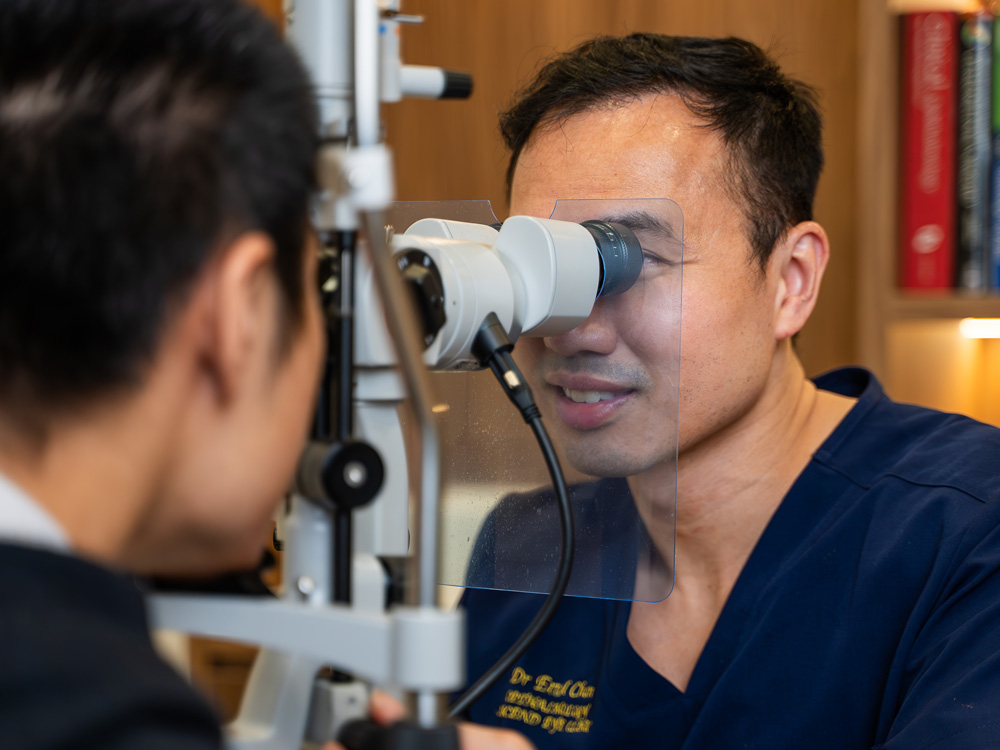
Your safety is our highest priority. Every diagnosis and treatment we provide is evidence-based to ensure that each step of your care is not only effective but also held to a high standard of safety and quality.
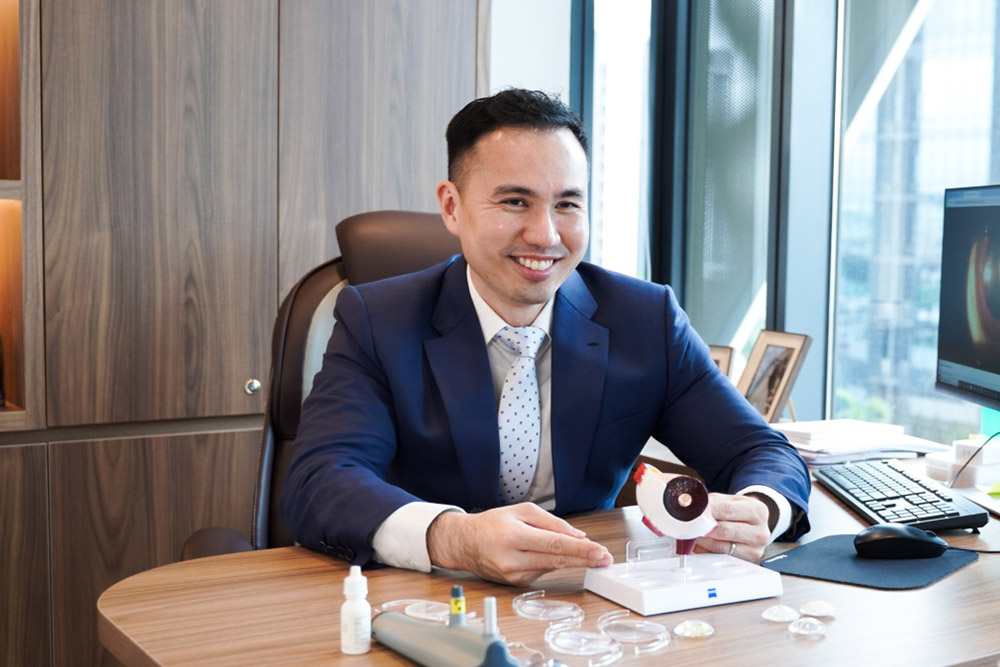
For pre-surgery, we will discuss all possible treatment options and recommends the most appropriate one for every patient. For post-surgery, we provide aftercare, including follow-up consultations and treatment plans tailored to every patient to promote optimal recovery.
Wish to book a consultation or have a question? WhatsApp Us!