
Presbyopia is the age-related loss of near focusing ability that typically begins in the 40s, making reading and close-up tasks increasingly difficult. Reading vision correction is tailored to improve near vision and reduce reliance on reading glasses, with options selected according to your eyes, lifestyle and visual needs.
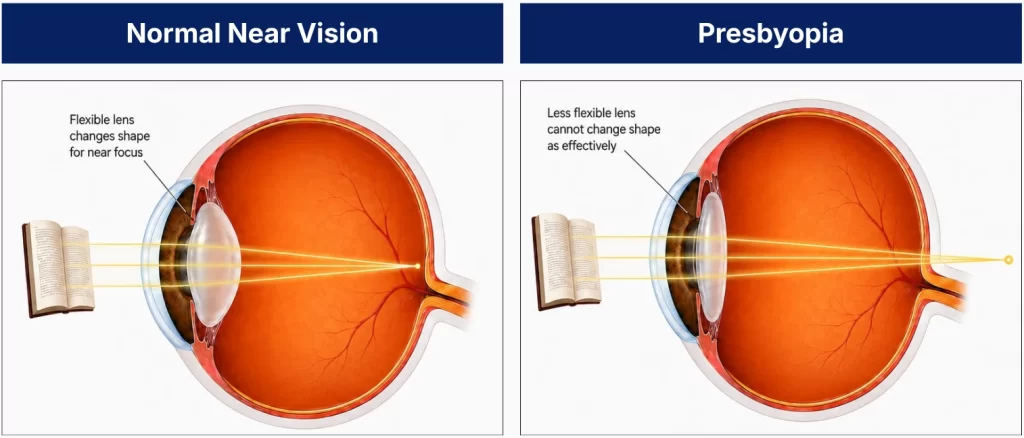
When you look at something up close, the natural lens inside the eye normally changes shape, becoming rounder to increase its focusing power, a process known as accommodation. With age, the lens gradually becomes stiffer and less flexible, reducing its ability to change shape and making it increasingly difficult to bring nearby objects into clear focus.
Presbyopia is the age-related loss of near focusing ability, caused by the natural lens gradually becoming stiffer and less flexible over time. As the lens loses its ability to change shape effectively, focusing on nearby objects becomes more difficult. This usually becomes noticeable in the early to mid-40s, when reading small print, checking your phone or doing close-up work starts to require more effort.

We offer surgical options to reduce the impact of presbyopia and lessen dependence on reading glasses. Treatment is tailored according to age, eye health, existing prescription, and the range of vision required for everyday activities.

Refractive Lens Exchange (RLE) and refractive cataract surgery both replace the eye’s natural lens with an artificial lens implant. The key difference is when they are performed: RLE is carried out before a significant cataract has developed, primarily to correct refractive errors and presbyopia, while refractive cataract surgery removes a lens that has already become cloudy from cataract formation while also aiming to reduce dependence on glasses.
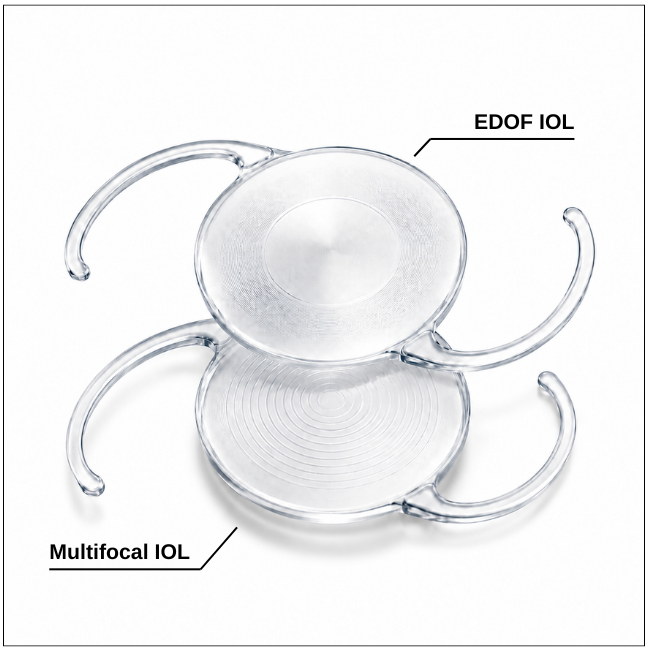
A wide range of lens implants can be selected according to your eye health, prescription, lifestyle, and visual priorities. Extended depth of focus (EDOF) lenses provide an extended range of clear vision, with particular emphasis on distance and intermediate vision while also providing useful near vision. Multifocal lenses divide focus across different distances to provide a broader range of distance, intermediate, and near vision, offering freedom from reading glasses and other corrective eyewear.
Different lens implants can be selected for each eye to better match your visual needs and goals. Depending on whether you prioritise distance, intermediate, or near vision, we can tailor the lens combination to provide a more personalised range of vision and reduce reliance on glasses.
All intraocular lens implants we offer come in their toric variants for astigmatism correction.
From your initial suitability assessment to treatment and structured aftercare, we guide you through every stage of your vision correction journey. Each step is carefully planned around your eyes, prescription and visual goals, so you know exactly what to expect before, during and after your procedure.
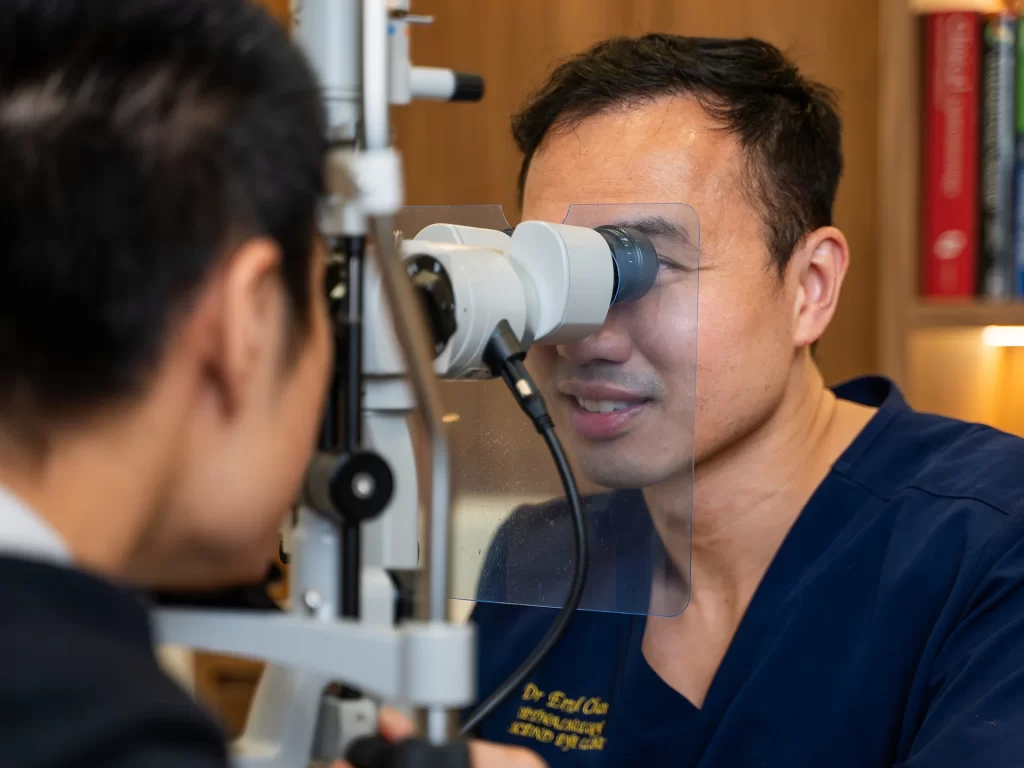
Your journey begins with a comprehensive assessment of your vision, prescription and overall eye health. Detailed measurements allow us to understand the shape and structure of your eyes and determine which vision correction options are suitable for you.
If you wear contact lenses, they will need to be stopped before your assessment so that your measurements are as accurate as possible:
We will review your results together with your visual needs, lifestyle and expectations, and discuss the treatment options that are suitable for your eyes. This allows you to understand the benefits, limitations and expected visual outcome of each option before deciding how you would like to proceed.
Your suitability assessment and vision correction procedure are performed on separate days, allowing your measurements to be carefully reviewed and your treatment to be planned for your individual eyes.
Vision correction can involve reshaping the cornea with laser treatment or implanting a lens within the eye, depending on the treatment selected during your suitability assessment.
Before your procedure, we will provide clear instructions on how to prepare, including any medications or eye drops that are required. We will also explain what to expect during treatment, your aftercare and any temporary activity restrictions during recovery.
All of our vision correction procedures are performed as day surgery. Anaesthetic eye drops are used to keep your eyes comfortable, with additional sedation used for selected lens-based procedures.
The exact steps and treatment time differ between procedures, but you will be guided through each stage so that you know what is happening throughout your treatment. You should arrange for someone to accompany you home afterwards, as you will not be able to drive immediately after your procedure.
Your vision will usually be blurred or fluctuate immediately after treatment as your eyes begin to recover. The degree of blurring and how quickly your vision improves depends on the type of vision correction procedure performed.
Your eyes can also feel watery, gritty, sensitive to light or mildly uncomfortable during the early recovery period. For lens-based procedures, it is also normal for vision to take some time to settle as the eye heals and adapts.
You will begin your prescribed eye drops after treatment and receive clear instructions on caring for your eyes at home. Resting your eyes, avoiding rubbing them and following your medication schedule are important during the early stages of recovery.
Your follow-up appointments allow us to assess your vision, examine how your eyes are healing and ensure that your recovery is progressing as expected.
Visual recovery differs between procedures. Some treatments provide rapid improvement within the first few days, while others require a longer period for vision to stabilise fully. We will explain the expected recovery timeline for your chosen procedure before treatment.
Caring for Your Eyes After Vision Correction
Our team remains available throughout your vision correction journey should you have any questions or concerns before or after your procedure.
Presbyopia affects everyone differently. A detailed assessment can help determine whether monovision LASIK, Refractive Lens Exchange or other approaches are best suited to provide clear vision for you across different distances.
Book a consultation to explore the available options and find a treatment plan that fits comfortably into everyday life.
This is usually due to presbyopia, an age-related loss of focusing ability caused by the natural lens becoming less flexible. It typically becomes noticeable from the 40s onwards, especially when reading small print, looking at a phone or working at close distances.
Presbyopia progresses as the natural lens continues to lose flexibility. Near focusing ability gradually reduces through the 40s and 50s before becoming relatively stable later in life.
Presbyopia primarily affects the ability to focus at near. Your underlying myopia, hyperopia or astigmatism remains a separate refractive issue, although these prescriptions influence how noticeable your presbyopia becomes.
For patients seeking a longer-term solution, we offer options including monovision vision correction and Refractive Lens Exchange. The appropriate approach depends on your age, prescription, eye health, natural lens and how you use your vision throughout the day.
Monovision gives the two eyes different focusing targets, usually with one eye prioritised for distance and the other for near. RLE replaces the natural lenses with intraocular lenses selected to provide the desired range of vision.
We assess your age, prescription, eye anatomy, natural lens, eye health and visual priorities. Monovision preserves the natural lens, while RLE becomes increasingly relevant as presbyopia progresses and age-related changes in the natural lens develop.
No. RLE is performed before a visually significant cataract develops when lens replacement is being undertaken primarily for vision correction. Once the natural lens is replaced, it does not later develop a cataract.
RLE is generally better suited to middle-aged and older adults whose natural lenses have already lost a significant amount of focusing flexibility. In younger adults, preserving the natural lens is usually preferable when another suitable vision correction option exists.
Monovision is often particularly relevant during the earlier stages of presbyopia because it provides near vision while preserving the natural lens. Suitability still depends on how comfortably your visual system adapts to the difference between the two eyes.
No treatment recreates the focusing ability of a young natural lens perfectly. The aim is to create a useful range of vision while balancing clarity, spectacle independence and visual quality according to your priorities.
Some patients function comfortably without reading glasses for most daily activities, while others still prefer glasses for very small print or prolonged close work. The degree of spectacle independence depends on the treatment strategy and visual target selected.
This depends on where your intermediate vision is targeted and the treatment selected. We specifically discuss computer distance during your assessment because intermediate vision is increasingly important for everyday work and device use.
RLE is planned around a selected refractive target for each eye. With monovision, one eye is intentionally focused closer, so binocular distance vision feels different from having both eyes corrected purely for distance.
One eye is deliberately focused at a different distance rather than being left uncontrolled or untreated. When both eyes are open, the brain combines the information from each eye and gives greater attention to the eye providing the clearer image for the task being performed.
Where appropriate, we simulate the intended visual balance before permanent treatment, commonly using trial lenses. This gives you an opportunity to experience the difference between the two eyes and assess whether the arrangement feels comfortable in everyday vision.
The visual target is reviewed rather than forcing you to accept an arrangement that does not suit you. This is why careful assessment and, where appropriate, a monovision trial are important before committing to a permanent correction.
Monovision introduces a difference in focus between the eyes, so some reduction in fine stereoscopic depth perception occurs. The amount varies between individuals and becomes particularly important for people whose work or hobbies demand very precise binocular vision.
Some patients notice reduced visual comfort in low-light conditions because the two eyes are focused differently. We assess your driving habits and visual requirements when deciding how much difference to create between the eyes.
The near requirement increases as the natural lens continues to age. A correction that works well during early presbyopia therefore requires review later, particularly if near tasks become more demanding.
RLE removes the ageing natural lens, so further loss of accommodation from that lens no longer occurs. The implanted IOL then provides the focusing strategy selected for your long-term vision.
The lens strategy is selected according to your visual requirements rather than using the same IOL for every patient. Options range from monofocal lenses to advanced lens designs that provide a broader range of focus, with toric versions available when astigmatism requires correction.
No. The two eyes do not always require identical lens designs or focusing targets. We plan each eye as part of a binocular strategy, and different lens types are used between the eyes when that combination better matches the patient's visual priorities.
The likelihood and character of halos or glare depend strongly on the treatment and lens design selected. Advanced IOLs that divide or extend focus produce different optical effects from monofocal strategies, and these trade-offs are discussed before lens selection.
The answer depends on your eyes and the range of vision you want. RLE with an appropriately selected lens strategy provides extensive flexibility across different distances, while monovision offers a lens-preserving approach for patients who adapt well to different focusing targets between the eyes.
We assess the entire eye rather than recommending a procedure based on age alone. If either option does not provide the right balance of safety and visual quality for your eyes, we will discuss the other appropriate vision correction or spectacle-based options instead.
Wish to book a consultation or have a question? WhatsApp Us!